
The board
The top of the board is a timeline from February to February with the key events of the year: training on the platform, recruiting, client chats and a team-building sprint. Below it is the client journey. On the right are four content tracks: video, site, text and people.
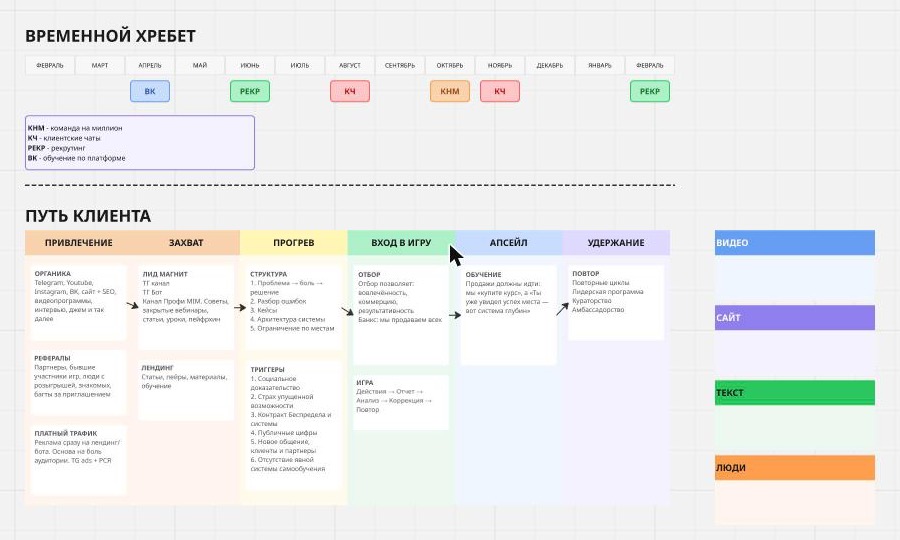
The yearly timeline
Twelve months in one row, with only a few marks. Each mark is a period where the content has to support one specific thing:
- Training on the platform (April) — educational content for new people.
- Recruiting (June and February) — stories and proof that attract new team members.
- Client chats (August and November) — warm-up content for existing clients.
- Team sprint (October) — a short, high-energy period with its own campaign.
Six stages of the client journey
- 1
Attraction
Organic channels (Telegram, YouTube, Instagram, website and SEO, video programmes, interviews), referrals and paid traffic. Video does most of the work here.
- 2
Capture
A lead magnet, a landing page and a Telegram channel or bot. The goal is a contact, not a sale.
- 3
Warm-up
A structure of five steps: problem → pain → solution, analysis of mistakes, cases, system architecture and limited places. Plus six triggers: social proof, fear of missing out, a contract, public numbers, new community and the absence of a clear self-study system.
- 4
Entry into the game
Selection and the game itself. Selection works as a filter: it admits those who are ready and lets the rest go.
- 5
Upsell
Training. The message: "you did not buy a course, you saw the success of the place and want the whole system".
- 6
Retention
Repeat cycles, a leadership programme, mentoring and ambassadorship. A client becomes a participant, then a guide.
Four content tracks
Video
Reels, Shorts, interviews and cases. Planned as a pipeline: 12 stages.
Site
Landing pages and materials that capture the contact and answer questions.
Text
Articles, posts and the warm-up sequence in the channel.
People
Personal conversations, chats and mentoring; the human part that content cannot replace.
How to use the map
Write each stage as a question: what does the person need to believe to move on? Then give every stage at least one piece of content. The empty columns show where the funnel leaks. For an example of one concrete route, see from Reels to a paid course.
Frequently asked questions
- Is this map only for courses?
- No. Replace "game" and "upsell" with your own steps: booking and repeat visit for a restaurant, brief and extension for a service. The six-stage logic holds.
- Why mark only a few events on the timeline?
- A crowded calendar is not a plan. Four or five anchors give the rest of the content a direction.
- Where do I start if I have nothing?
- With attraction and capture: a few short videos and one place that collects contacts. Add warm-up when people start arriving.
- Can you help build this for my business?
- Yes, the audience and strategy stages come first in my process: how to define your audience.